
Hampshire County Genealogy Records
Hampshire County genealogy records span more than three centuries of settlement along the Connecticut River Valley, covering land deeds, probate files, vital records, and court documents for twenty towns in western Massachusetts. Researchers tracing Pioneer Valley ancestors will find the bulk of their primary sources at the Hampshire County Registry of Deeds in Northampton, the Probate and Family Court, the Massachusetts State Archives in Boston, and through the free online tools available at MassLandRecords and FamilySearch.
Hampshire County Overview
Hampshire County Registry of Deeds
The Hampshire County Registry of Deeds sits at 33 King Street in Northampton and holds land records going back to 1787. Every deed, mortgage, easement, and land transfer recorded in the county is kept here. For genealogy work, deeds are one of the best sources available. They show when an ancestor bought or sold land, where they lived, and often name relatives, since heirs were frequently listed in conveyances and releases.
Free online access is available through MassLandRecords, part of the statewide land records portal. All documents recorded after January 1, 1928 are searchable by name, book and page, document number, property address, and recorded date. Document images are included. The office is open Monday through Friday, 8:30 AM to 4:30 PM. You can call 413-584-3110 with questions about specific records or older documents.
The online collection goes beyond basic deeds. All recorded land plans are indexed with images going back to 1800. Registered land plans are searchable by court case number from 1899 to the present. Hampshire County also holds some unique historical collections worth knowing about.
One standout resource is the Beers Atlas Maps from 1863. These are images of the F.W. Beers Atlas Maps for Hampshire County, which show property owners by name on detailed town maps. If your ancestor owned land in the county around the Civil War period, there is a good chance their name appears on these maps. They can help you confirm where a family lived and identify neighbors, who were often relatives. Assessor's maps are also available through the online search tool.
Another major collection is the Proprietor Records from the Hampshire Proprietors books, covering the years 1653 to 1835. These cover several Pioneer Valley towns: Hatfield, Granby, Hadley, Narragansett Township No. 4, Northampton, Pelham, and South Hadley. Proprietor records document the original land grants and divisions in early Massachusetts towns. Finding an ancestor in these records places them among the earliest settlers of the region.
The MassLandRecords statewide portal provides free access to Hampshire County deed records and land documents going back to the earliest available records.
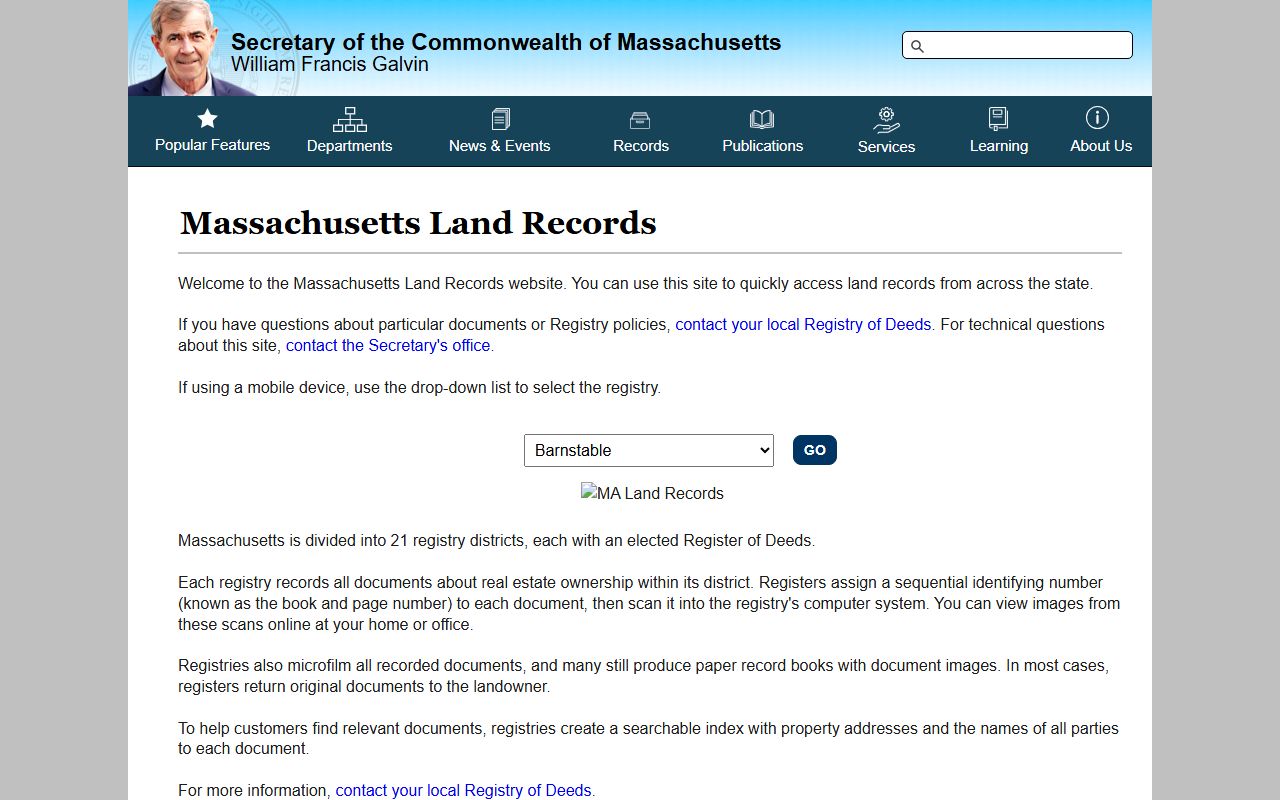
Hampshire County deed records are fully searchable through the free MassLandRecords portal, letting researchers find land transactions and property transfers from home.
| Office | Hampshire County Registry of Deeds |
|---|---|
| Address | 33 King St, Northampton, MA 01060 |
| Phone | 413-584-3110 |
| Hours | Monday-Friday, 8:30 AM - 4:30 PM |
| Online Search | masslandrecords.com/hampshire |
Hampshire County Probate and Family Court Records
Probate records are a core source for family history research. The Hampshire County Probate and Family Court is at 15 Gothic Street in Northampton. The phone is 413-584-5810. Court records include wills, estate inventories, administration papers, guardianship files, and dower releases. These documents often name children, grandchildren, siblings, and other relatives by name, and they frequently include addresses, occupations, and precise family relationships.
There is an important detail Hampshire County researchers need to know. When Hampden County was formed in 1812, some towns moved into the new county. But their probate records from before 1812 stayed at Hampshire County in Northampton. If you are researching ancestors from towns that are now in Hampden County and your research reaches back before 1812, you need to check the Hampshire County Probate Court, not Hampden.
Similarly, when Franklin County was separated from Hampshire in 1811, deeds for Franklin County towns that had been recorded at the Deerfield registry were transferred to Greenfield in 1812. Pre-1812 deeds for those towns were recorded at Hampshire. So Hampshire County records can reach into what is now both Hampden and Franklin counties for the earliest period. This overlapping jurisdiction is one of the trickier aspects of Hampshire County genealogy research, and it catches many researchers off guard.
For FamilySearch users, the site at familysearch.org has a detailed wiki page for Hampshire County that lists digitized collections and explains what records are available online for free. This is worth checking before making a trip to the courthouse.
| Office | Hampshire County Probate and Family Court |
|---|---|
| Address | 15 Gothic St, Northampton, MA 01060 |
| Phone | 413-584-5810 |
| Key Note | Pre-1812 probate records for Hampden County towns are filed here |
Vital Records for Hampshire County Genealogy
Vital records for Hampshire County follow the same structure as the rest of Massachusetts. The state began systematic registration in 1841. For records from 1841 to 1925, the Massachusetts State Archives at 220 Morrissey Boulevard in Boston is the main holder. Copies made in person cost $3 each. For records from 1926 forward, contact the Registry of Vital Records and Statistics in Dorchester.
For events before 1841, the primary sources are town clerk records and church registers. Each of the twenty towns in Hampshire County kept its own birth, marriage, and death records going back to the colonial period. Many of these early records were published as part of the Massachusetts Systematic Series of town vital records, and copies are available at libraries and through FamilySearch. Northampton, Amherst, Hadley, Hatfield, and other early towns all have published early vital records.
Under M.G.L. Chapter 46, Massachusetts law governs the registration and access rules for vital records statewide. Town clerks are required to keep these records, and the law spells out who can access them. Older genealogy records are generally open to the public. More recent records may have restrictions based on the relationship to the person named in the record.
You can order certified copies of birth, marriage, and death certificates through the state at mass.gov. FamilySearch offers free access to Massachusetts Town Clerk records from 1626 to 2001 and state vital records from 1841 to 1920. These are a solid first step before paying for official copies.
Pioneer Valley Research: What to Know
Hampshire County sits in the Connecticut River Valley, one of the earliest regions of European settlement in inland New England. The towns along the river, including Northampton, Hadley, Hatfield, and Deerfield, were settled in the mid-1600s and have deep colonial records. Settlement in the hill towns to the west and east came later, mostly in the 1700s. Knowing when your ancestor's town was settled helps set realistic expectations for what records exist and how far back they go.
The Five College area, home to the University of Massachusetts Amherst, Amherst College, Smith College, Mount Holyoke College, and Hampshire College, means that the county has strong library and archive resources. The W.E.B. Du Bois Library at UMass and the Forbes Library in Northampton both hold local history and genealogy collections that complement the official court records. The Forbes Library in particular has a strong local history room with Northampton and Hampshire County materials.
Migration patterns in this region often ran north-south along the Connecticut River. Ancestors who appear in Hampshire County may have come from Connecticut towns, and they may have moved on to Vermont or New Hampshire. Checking records in neighboring states is often productive for families with Hampshire County roots.
American Ancestors, the New England Historic Genealogical Society, holds manuscript collections and databases that cover Hampshire County families. Their online databases and Boston library are valuable complements to the official court and registry records. The Library of Congress also maintains a useful research guide for Massachusetts local history and genealogy at guides.loc.gov.
Note: Hampshire County towns include Amherst, Belchertown, Chesterfield, Cummington, Easthampton, Goshen, Granby, Hadley, Hatfield, Huntington, Middlefield, Northampton, Pelham, Plainfield, South Hadley, Southampton, Ware, Westhampton, Williamsburg, and Worthington. Records for all these towns are held through the Hampshire County offices in Northampton, though each town also keeps its own vital records.
Cities and Towns in Hampshire County
Hampshire County has no cities that meet the population threshold for individual pages on this site. The county includes twenty towns, with Northampton as the county seat and Amherst as the largest community. Records for all Hampshire County towns are maintained through the county registry and probate court offices in Northampton, along with each individual town clerk's office.
Nearby Counties
Hampshire County shares borders with four neighboring counties. If an ancestor lived near a county line, it is worth checking the neighboring registry as well, since deeds were sometimes recorded across county lines, especially in early periods.